

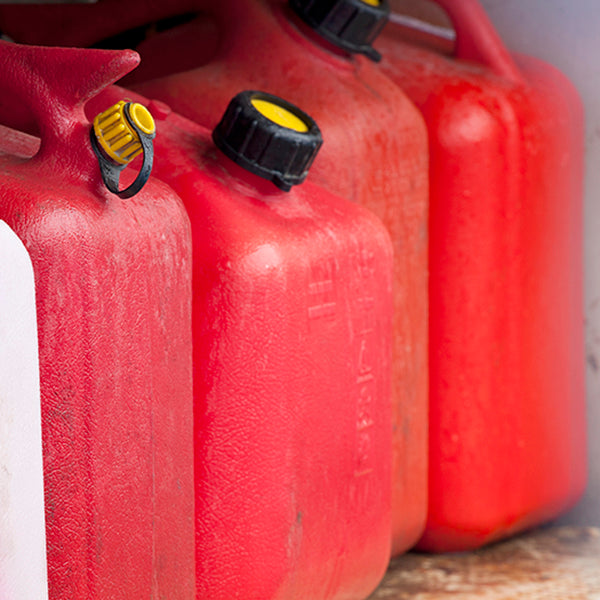
What are Flammable Liquids?
Flammable liquids are liquids that can burn. They are either classified as flammable or combustible based on their flashpoints. A flashpoint is the lowest temperature at which a liquid gives off enough vapour to start burning.
Class 3.1 flammable liquids are split into four sub-classes:
- Class 3.1A: an example of which is petrol
- Class 3.1B: examples include acetone (used in nail polish remover) and ethanol (used in hand sanitisers)
- Class 3.1C: an example of which is p-xylene (used in the manufacturing of PET plastic bottles)
- Class 3.1D: an example of which is diesel
Where are Flammable Liquids most likely to be found?
Common flammable liquids are petrol, acetone, ethanol and thinners. Common workplaces where flammable liquids can be found include workshops, mechanics, and manufacturing plants.
As mentioned above, hand sanitiser is often a highly flammable substance as some hand sanitisers contain over 70% alcohol meaning it is a class 3.1b hazardous substance. If you have more than 15L on site, you will need to store it in an approved storage cabinet.
What are the risks to people and the environment?
In its broadest sense, the risk of fire is something that nearly every human being on earth is exposed to every day. This is particularly true in a business or industrial setting, when we increasingly work with flammable liquids, or substances that will liquefy in the event of a fire. The risks of flammable liquids can be high and there are certain regulations you must follow when storing flammable liquids.
Very few businesses are exempt from the risks of working with Class 3 flammable liquids. Whether you are in manufacturing, food production or warehousing, transport, agriculture or automotive repair, there is a high chance that handling and storing those substances correctly is of concern to you.
How do I store Flammable Liquids?
Flammable liquids cannot be stored in any old cabinet. Flammable storage cabinets serve a number of key purposes.
Heat resistant
- They provide a heat-resistant enclosure of flammable liquids, preventing or containing the destructive effects a fire might ordinarily have, on both your staff and your business operation
Compact size
- They are relatively compact which means a cabinet can often be situated in close proximity to where the liquids are used, creating numerous efficiencies compared to centralised storage
Secure storage
- They can also help clean up untidy storage areas, allowing you to secure and isolate flammable liquids from those that are harmless or non-compatible – or from people that shouldn’t have access to them.
Hazero Flammable Cabinets are available in six sizes:
- Hazero Flammable Cabinet - 30L | 41-0301
- Hazero Flammable Cabinet - 60L | 41-0302
- Hazero Flammable Cabinet - 100L | 41-0303
- Hazero Flammable Cabinet - 160L | 41-0304
- Hazero Flammable Cabinet - 250L | 41-0305
- Hazero Flammable Cabinet - 250L Plus | 41-0306
You can only store up to 250L in a cabinet (as long as each container is not over 20L in size). The larger Hazero Flammable Cabinet – 350L, is available for users who may have larger sized containers that would not fit in a 250L cabinet.
Larger quantities of liquid may require a location certificate but either way, an approved storage cabinet is often the fastest and most economical way to safely and compliantly store your flammable liquids.
When is a flammable liquids cabinet needed?
A flammable liquid cabinet is required when the aggregate quantity present is over the following thresholds:
- Class 3.1A or 3.1B = 15L
- Class 3.1C = 100L
- Class 3.1D = 500L
What are the design requirements for cabinets?
It is important to note that flammable liquids cannot be stored in any old cabinet and there are a number of requirements stated in AS 1940-2017 Standard “Storage and handing of flammable and combustible liquids.”. These requirements are outlined on page 188 of the Act, which are summarised below:
- Each package (within) does not contain more than 20 L
- The aggregate quantities of all packages of Class 3.1A, 3.1B or 3.1C held in the cabinet does not exceed 250 L
- The cabinet is constructed and installed in accordance with sections 4.9.2, 4.9.5 and 4.9.7 of AS 1940-2004
AS 1940-2017 is the standard states the cabinet construction requirements and the key points are summarised as follows:
- The walls, floor, door and roof shall be double-walled sheet steel
- The inner base shall form a liquid-tight compound that is at least 150mm deep
- Cabinet doors shall be self-closing, close-fitting and latched at 2 or more points
- Any shelves shall be perforated to permit free air movement
Where can I put a flammable cabinet?
Hazero Flammable Cabinets are for indoor use.
Hazero Flammable Cabinets should not be placed near ignition or heat sources as vapours can release and cause fires/explosions. If you have multiple flammable cabinets in one room, they must be 3m apart.
It is also a good idea to store them away from direct sunlight, or in very hot rooms.
Does a Flammable Cabinet need to be earthed?
A question we are frequently asked is, does my Hazero Flammable Cabinet or Hazero Gas Cylinder Store need to be earthed? The short answer is no – earthing is not normally required.
Earthing refers to letting electricity ‘escape’ from a cabinet if it becomes live. To do this the cabinet would need to be connected to the ground, this would protect the cabinet from electric shocks and discharges. As it is unlikely a Hazero Flammable Cabinet would be connected to an electrical circuit (and therefore is unlikely to be ‘live’), earthing is not normally required.
Bonding is the term used when connecting metallic items not designed to carry electricity. As a storage cabinet, or cage, is unlikely to make contact with a piece of metal with another potential and thus become ‘live’ (from the difference in potential) – bonding is not normally required.
It should be noted that under regulations 10.11 10.11(2), 10.13(6), 10.17(5) and 10.19(5) of the HS Regulations, any permanently fixed containers must be earthed and bonded – above threshold quantities.
For further information please refer to the WorkSafe website.
Incompatible substances
Please consult the Dangerous Goods Segregation Chart for specific details.
Need help creating a safer working environment? Contact our team today on 0800 688 844 or email us at help@hazero.co.nz.
Content above falls under the Hazero Disclaimer, for more information click here.
Share:
Loose Absorbents – An Overview
Spill Kits – An Overview